
Welcome
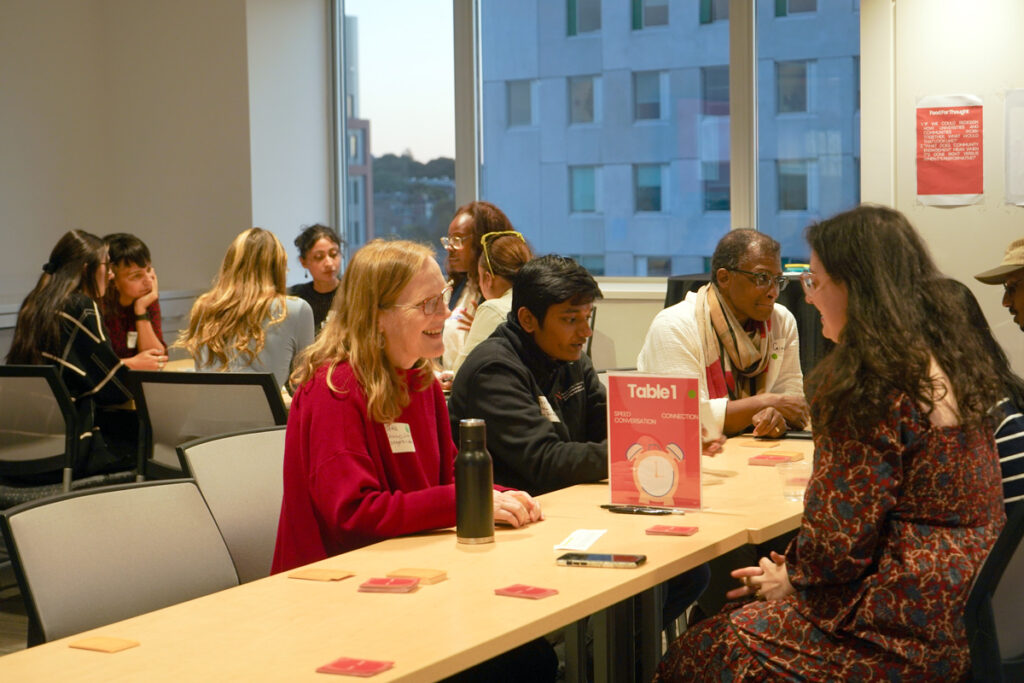
Welcome to the November 2025 Newsletter! We are excited to reflect with you on an energizing fall. In late September, we were honored to participate in “The Way We Were: Roxbury Black Wall Street.” Additionally, our first Hidden Histories Artists-in-Residence, Joanna Tam and Lani Asunción, led their first workshop “Re-Mix, Re-Map, Re-Imagine: Activism in Boston Chinatown” in mid-October. Also in October, we collaborated with Community-Engaged Teaching and Research on the Runway to Community Learning with three interactive workshops. And on October 24, 2025, four hundred people joined in celebrating Sonny Carrington as the 2025 Boston Jazz Luminary in a moving concert at Union Church.
We are deeply grateful for our Fall 2025 student collaborators: multimedia editor co-op Octavia Zagorec; UnderEcologies digital assets manager and research co-op Afra Ankita; doctoral research assistants Kehinde Ilegbusi, Poppy Lambert, and Sayyara Poliferno; project assistants Safia Ibrahim and Holly Lyczak; Humanities in Action assistant Aiswarya Nair; research assistants Alex Booker and Keir Nason; and archival assistants Hale Murch and Alexa Richman. And we are delighted to share reflections from the 2025 Nieves Memorial Mellon Scholars recipients, ThankGod C. Ahumibe and Cassidy Loft.
Please follow us via our mailing list, Instagram (@reckoningsproject) and our website. Later this fall, we will be in touch with Spring events in the Community Network Series, including a new workshop led by Artists-in-Residence Joanna Tam and Lani Asunción.
And please contact Dzidzor Azaglo or Jen Grieve with any collaboration ideas or suggestions for improving our outreach!
Yours,
The Reckonings Team
Updates
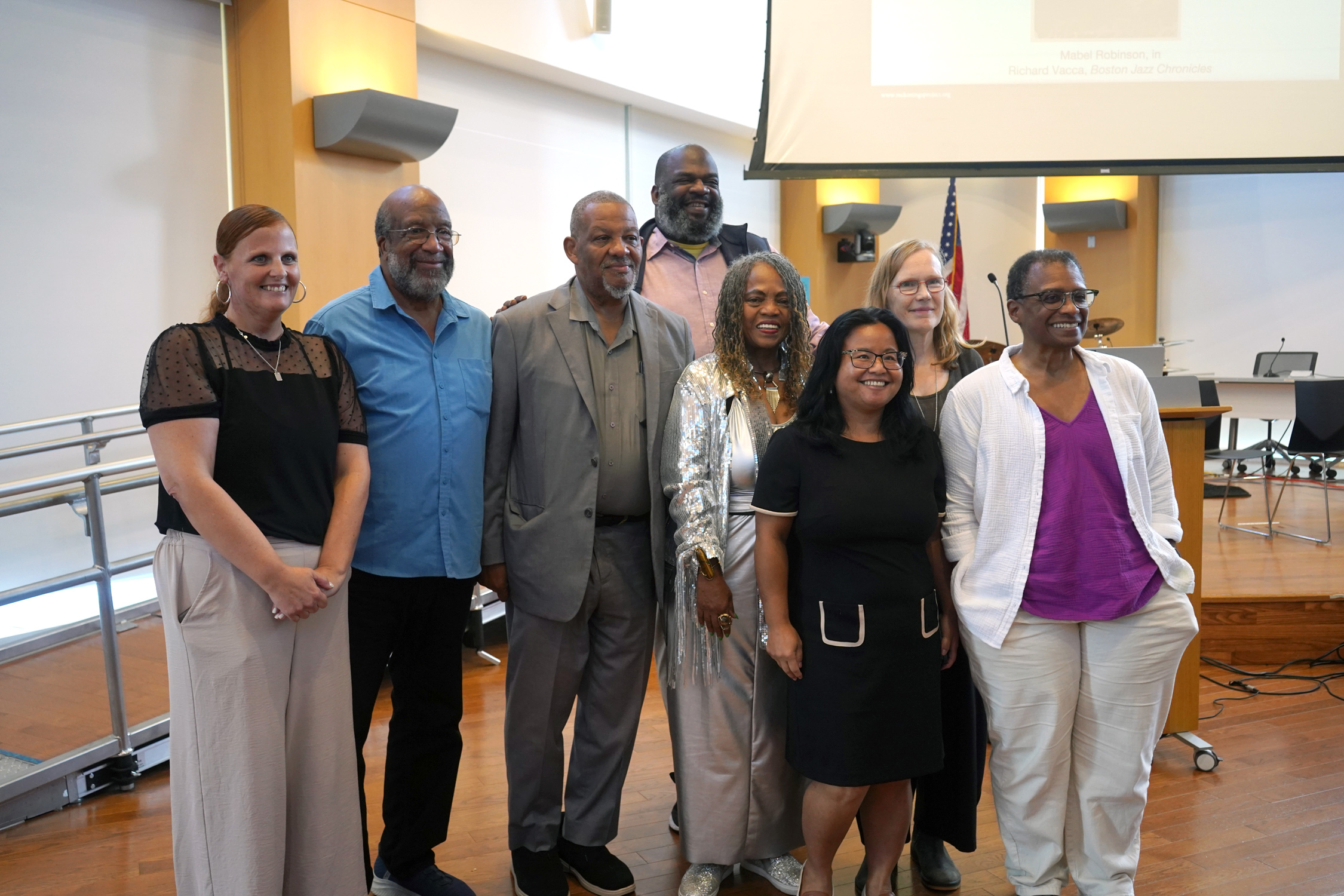
The Reckonings Project at The Way We Were Conference
Over the last few months, Marie Firmin has inspired Roxbury community members, archivists, historians, policy leaders and students to think actively about the history of Roxbury’s and South End’s Black businesses and the lessons we can take from that history for a vibrant future. In September, Marie convened and curated The Way We Were: Roxbury Black Wall Street, 1900-1065! from Tuesday, September 23rd through Friday, September 26th. Participants came together to celebrate and reflect on Roxbury’s rich legacy of Black entrepreneurship, art, culture, and history.
Each day of the program highlighted a different aspect of Roxbury’s Black experience and history, weaving together research presentations, oral histories, and live performances of music and sketches. Attendees had the opportunity to engage with scholars, community leaders, and artists who shed light on the historical roots of Roxbury as a vibrant hub of cultural and economic life.
On Wednesday, September 24, Reckonings Project Assistant, Safia Ibrahim, spoke about the life and legacy of activist, educator, and entrepreneur E. Alice Taylor. E. Alice Taylor (1892–1986) was born in Arkansas and later moved to Boston in 1927, where she lived for the rest of her life. From 1927 to 1942, Taylor managed a branch of Annie Malone’s Poro School and Beauty Shoppe in the South End. Under her management, it became the largest minority-owned business in New England at the time. After the Poro School closed, Taylor continued to support women and African Americans in the workforce. She co-founded and worked with multiple community organizations, and she was a committed member of the NAACP for 50 years, holding several officer positions throughout her involvement.
On Thursday, September 25, Reckonings Community Liaison, Dzidzor Azaglo, gave a reading from “How I Survived the Sierra Leone Civil War and Other Untold Stories,” written by Andrea Rosario-Gborie.
On Friday, September 26th, the Reckonings Project had the privilege of contributing to the celebration at the Bruce Bolling Building with its work on Jazz Square Activation. The day began with a presentation by Northeastern archivist Gina Nortonsmith on hotels, bars, rooming houses, restaurants and clubs that her research in Black business directories and the Green Books for Boston has revealed. Reckonings faculty member Uta Poiger shed light on the Boston jazz scene around Jazz Square (the intersection of Mass Ave. and Columbus Ave.), reflecting on ownership of the clubs such as Wally’s, the Savoy, and Conolly’s as well as the leading roles of bandleaders and pianists Sabby Lewis and Mabel Robinson Sims from the 1930s to the 1960s. In these years, the center of the Boston jazz scene was the area of today’s Jazz Square and Columbus Ave. and Tremont St., the same area that Gina Nortonsmith and her collaborators’ visualizations have revealed as Roxbury’s Black Wall Street and as the area welcoming Black customers during a time when many hotels, bars and restaurants did not serve Black customers. Visitors to the Isabella Stewart Gardner Museum can currently see Allan Rohan Crites’s oil painting Columbus Avenue from 1937, featuring a street scene with the Hi-Hat Club in the exhibit Allan Rohan Crite: Urban Glory.
A panel discussion featuring Leland Clark, Jim Braxton, Heang Ly, and Shana Penna; several skits about restaurants and nightlife; and a presentation on the long history of Slade’s on Tremont Street by its current manager, Britney Kyle Papile, rounded out the day. After lively discussions, audience members danced to Pat Braxton and her band’s performance of Billie Holiday songs. Throughout the day, the Reckonings Project exhibited posters on the history of jazz clubs and of major musicians, as well as the map of Boston jazz locations that the project has been working on for the last few months, a project currently led by UnderEcologies co-op Afra Ankita. We look forward to continuing and deepening the collaborations on Black entrepreneurship and Boston jazz history with Marie Firmin, Northeastern Archives and Special Collections, and Jazz Square Activation, and hope to bring additional collaborators into this work of jazz history-making.
by Octavia Zagorec
“Re-Mix, Re-Map, Re-Imagine: Activism in Boston Chinatown:” Artists-in-Residence Lead October Workshop in the Reckonings Community Network Series
On October 14, Reckonings’ Artists-in-Residences Joanna Tam and Lani Asunción invited workshop participants to activate the language found in Asian American Resource Workshop (AARW) newsletters, through creative mapping and collective imagination. AARW is a political home for pan-Asian communities in Greater Boston, committed to building grassroots power through political education, creative expression, and issue-based and neighborhood organizing. AARW offices used to be in Chinatown and have since moved to Dorchester, to the area now designated Little Saigon, in order to work effectively with the communities of Boston’s changing neighborhoods. Tam and Asunción, as well as Nicole Eigbrett, Co-Executive Director of AARW, and Billy Zeng, Dorchester Program Coordinator of AARW, introduced AARW and the workshop activities.
In the course of the evening, workshop participants split into three groups and shared reflections on climate justice and making AANHPI (Asian American, Native Hawaiian, and Pacific Islander) more inclusive, offering layered perspectives on how activism takes root in local histories and lived experience. Participants discussed how personal and collective identities influence engagement in social movements and how environmental justice remains tied to struggles for belonging and survival. Participant teams then wrote key words and phrases on large pieces of fabric, hand-dyed by Joanna Tam with tea, and then joined them together, making a big piece of work.
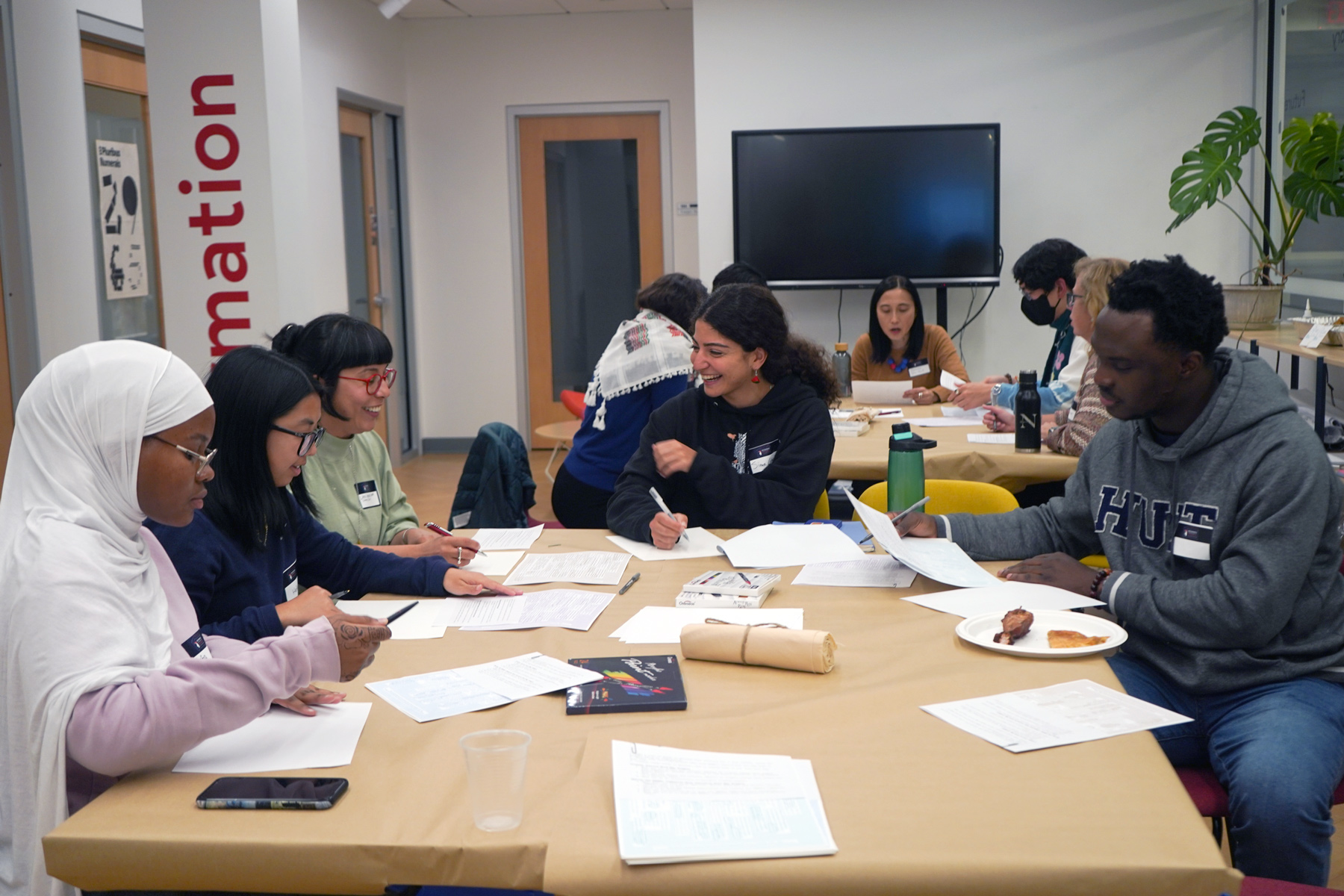
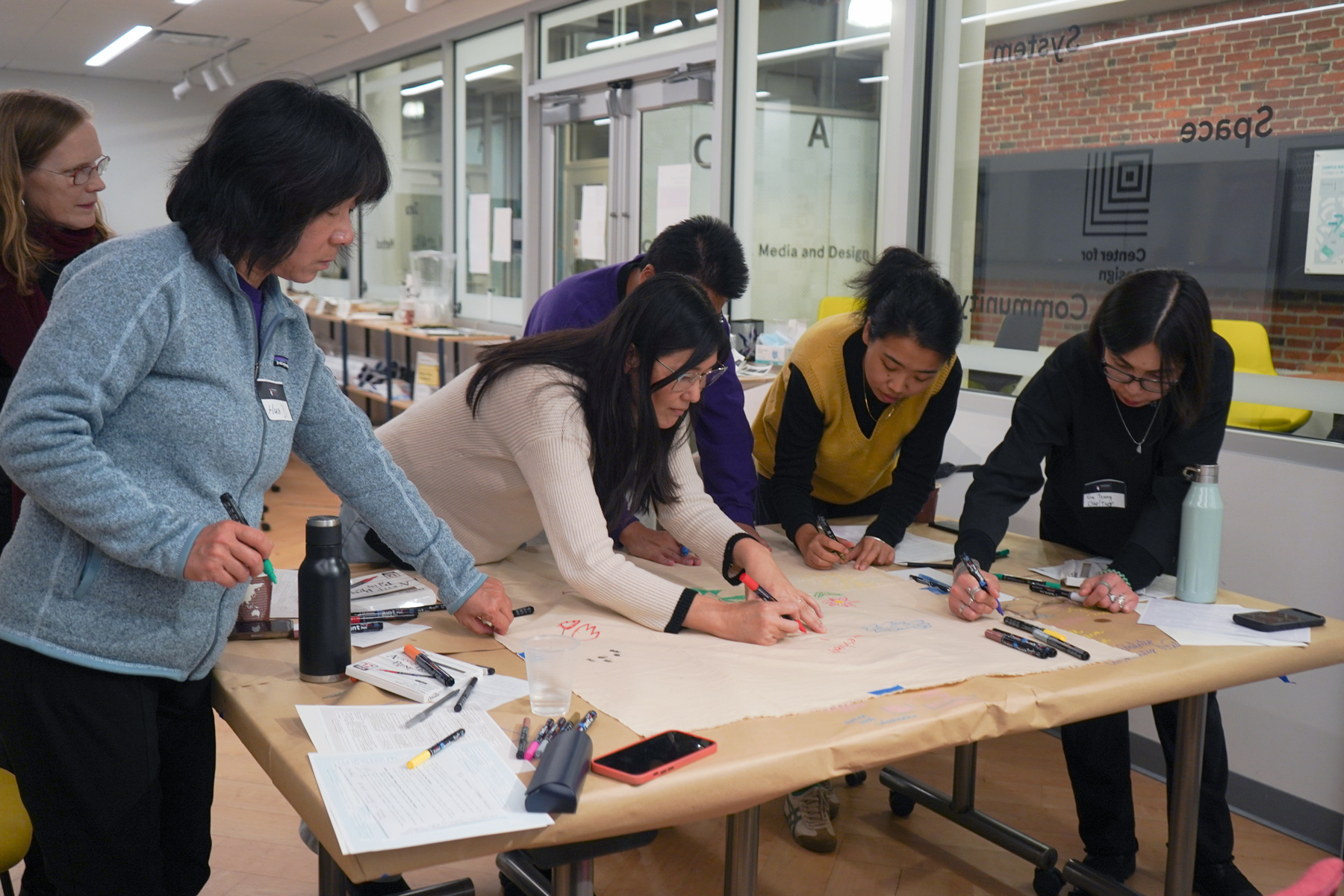
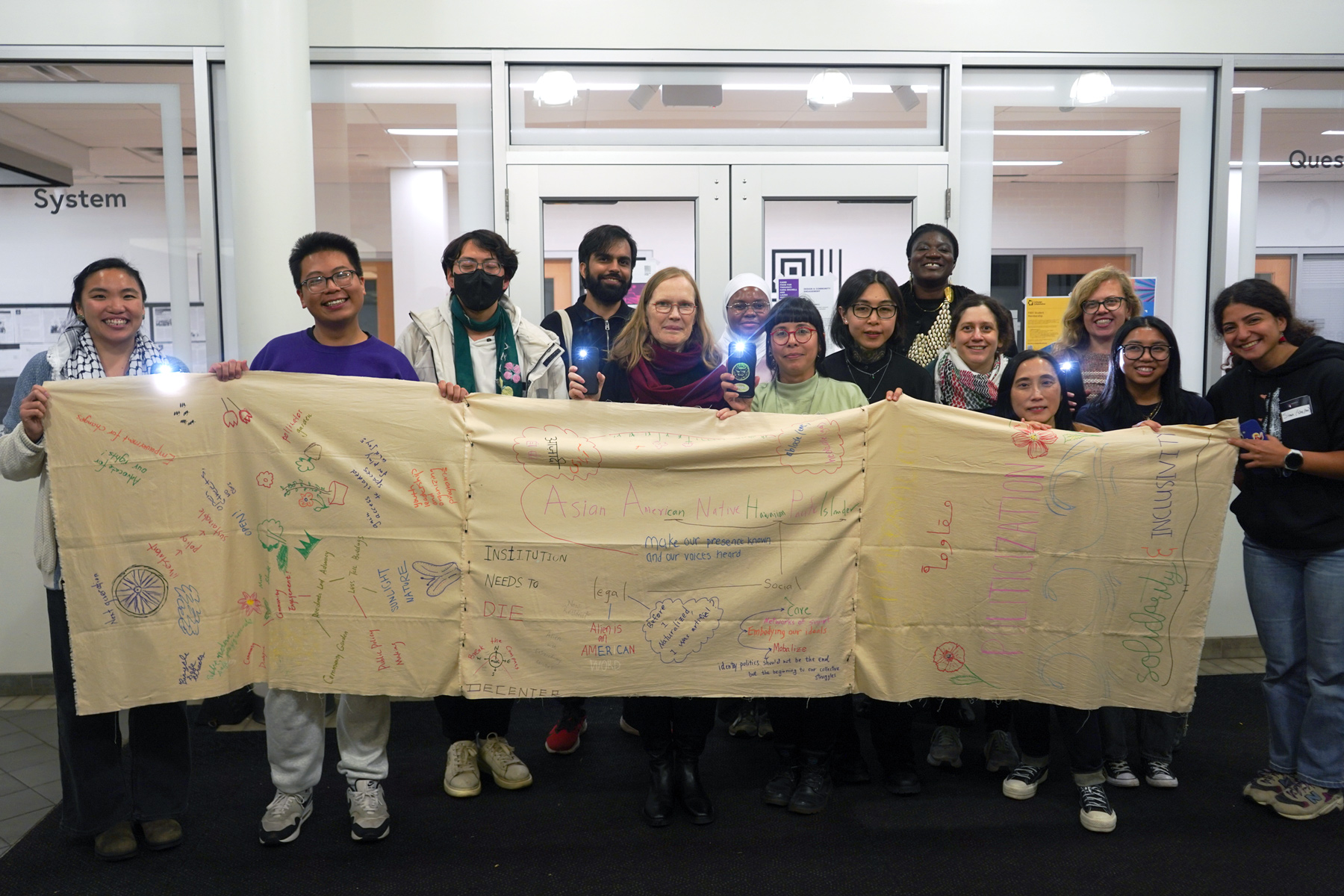
Tam and Asunción’s facilitation of this workshop emphasized collaboration and embodied learning, transforming the archival materials into a living site of visualization and conversation.
Their work with the Reckonings Project, in partnership with Northeastern’s Archives and Special Collections and Center for Design, highlights how art and public history can intersect to spark dialogue about race, place, and resilience.
To learn more about the artists and the Hidden Histories Artists-in-Residence Program, visit reckoningsproject.org/artistsinresidence.
Follow their work on Instagram at Joanna Tam (@joanna_tam) and Lani Asunción (@lani.asuncion).
by Octavia Zagorec
Two Master’s Students Work with Community Partners, Supported by the Ángel David Nieves Memorial Mellon Scholarship
For the second summer, two Nieves Memorial Mellon Scholars worked for partner organizations, supporting them in their mission of creating experiences around community histories, with a focus on community archiving, social justice, and oral and digital storytelling.
At the end of the summer, the two scholars and master’s students, ThankGod C. Ahumibe and Cassidy Loft, reflected on their experiences. During his internship with the Black Heritage Trail New Hampshire, ThankGod C. Ahumibe, a master’s student in English, worked closely with Executive Director, JerriAnne Boggis, and Operations Manager, Gina Bowker, to support a website redesign. His primary role was editing, reorganizing and formatting the “New Hampshire Black History Stories” collection, ensuring accuracy and accessibility for researchers and community members. He says:
“Post-internship, I believe I am better trained and guided in research and interpretation in public history practice. I intend to continue to pursue future public-facing community engagements that allow participants to learn and unlearn from research and the lived experiences of one another.”
Gina Bowker praises Ahumibe’s work saying:
“ThankGod’s thoughtful attention to detail helped us to create a collection that stands as both a scholarly tool and a welcoming entry point for anyone eager to explore the often overlooked African American history in the Granite State.”
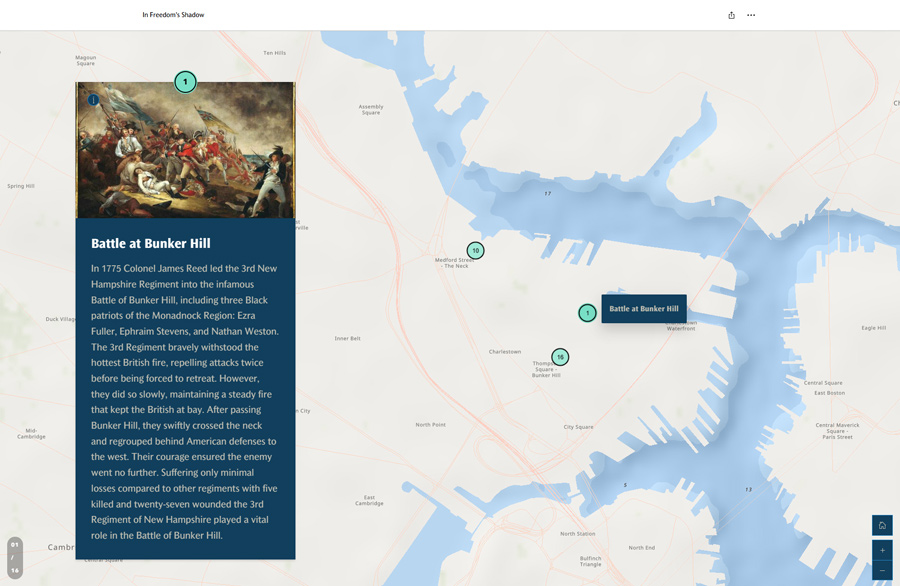
Cassidy Loft, a master’s student in Public History, partnered with the Cheshire and Peterborough Historical Societies to research and highlight Black patriots of New Hampshire’s Monadnock Region who fought in the Revolutionary War. She organized and cleaned complex datasets in Airtable, created an ArcGIS Interactive Heat Map (not yet published) and narrative StoryMap, and developed interactive visuals that preserve, contextualize, and share these important histories as the nation approaches its 250th anniversary. As Loft explains:
“Through these maps I hope to share insight into the legacies of the Black patriots of the Monadnock Region and how interweaved they are in our history as a country. I have worked to make these stories both reliable and engaging for researchers, educators, and the broader public. While challenges remain and further research is needed, the progress made demonstrates the importance of preserving and amplifying these narratives. These will eventually be published in a cohesive website completed by late March 2026.”
Reckonings is delighted that support from the Mellon Foundation will allow future Nieves Memorial Mellon Scholars the experience of being mentored by community partners, while contributing to their mission of telling innovative community histories.
by Octavia Zagorec
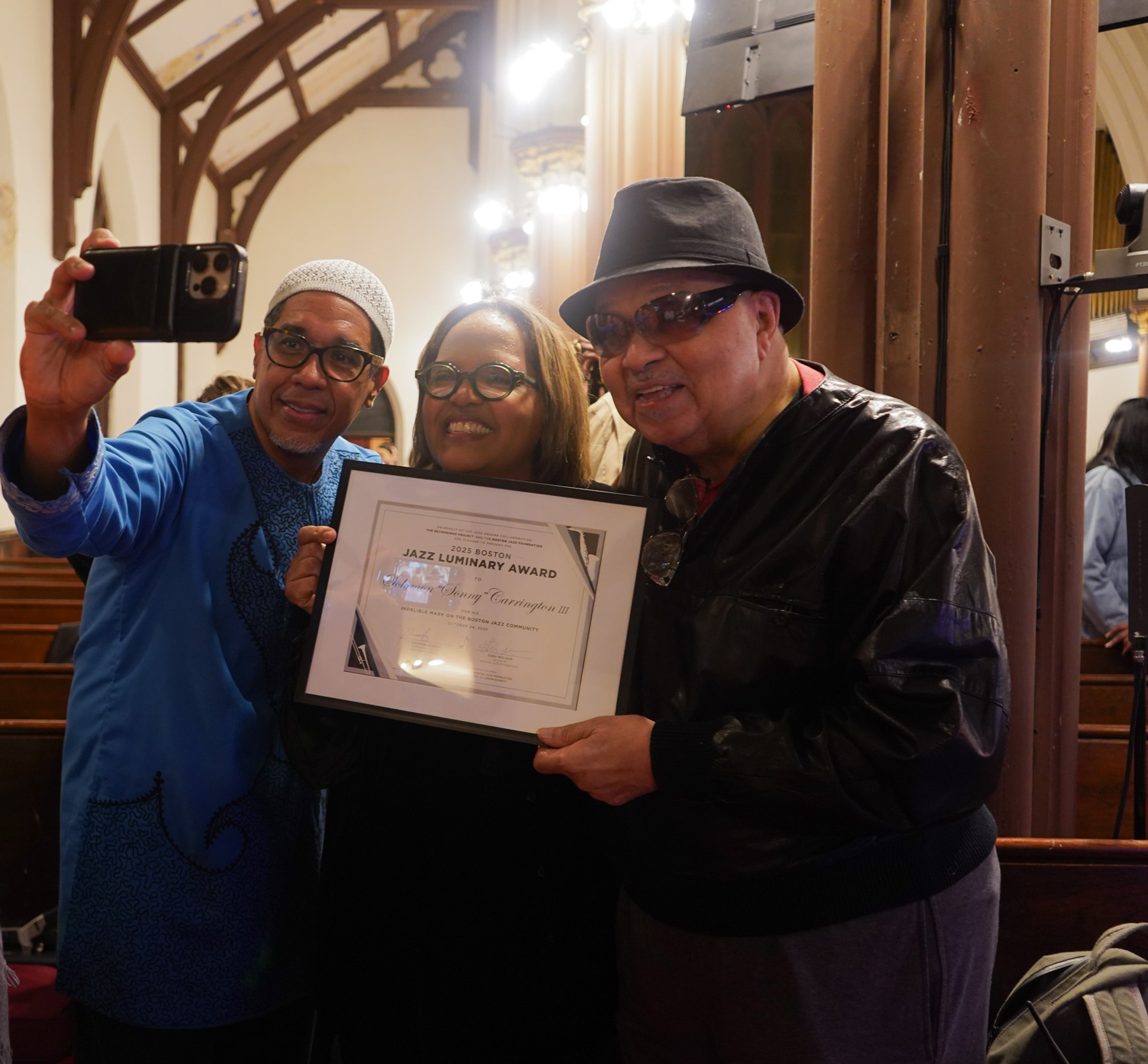
Jazz Square Activation Honors Solomon “Sonny” Carrington III with the 2025 Boston Jazz Luminary Award
Some events create special memories that last long after the event is over. The gathering and performances on the evening of Friday, October 24, 2025 at Union Church created that feeling – by celebrating the contributions of Boston jazz legend Solomon “Sonny” Carrington III as a saxophonist, drummer, motivational speaker, educator, and organizer. Performers, speakers, and the multi-generational audience honored Sonny with the 2025 Boston Jazz Luminary Award. Ron Savage, Vice President and Executive Director of Berkeley College of Music, presented Sonny with the award, sharing Sonny’s biography and the impact that Sonny has had on him and so many others: “Sonny parented many jazz musicians. He encouraged me to take my studies seriously.” Dzidzor Azaglo and Uta Poiger used their introduction of Ron Savage to remind the audience that the Reckonings Project’s motto, “We Are Here,” means “We Were Here” – a symbol of our Jazz Square Activation partnership with the Boston Jazz Foundation, Claremont Neighborhood Association, and Union Church. Celebrating jazz musicians and organizers of the jazz scene and jazz education in Boston, past and present, and inviting audiences to enjoy and appreciate jazz in Boston today is all part of Jazz Square Activation.
“This never happened to me before.” Thus began Sonny’s remarks. Sonny’s joy and memories of interacting with jazz legends like Charlie Parker or insisting that jazz teaches young and old key life lessons filled our hearts as a community. Sonny has mentored and inspired not only his daughter, NEA Jazz Master and four-time Grammy-winning percussionist Terri Lyne Carrington, but many other jazz artists like Ron Savage, as well as numerous young students. We are grateful for his impact both on and off the stage.
Jose Soto, an award-winning Costa Rican pianist and educator, and his band began the evening with a powerful performance, blending jazz with Indigenous storytelling. They played pieces from their album, The Ancestral Call, inspired by the Bribiri Indigenous people in Southern Costa Rica and along the border with Panama. Their music connects us to jazz as an art that adapts to different cultures while maintaining its cultural significance rooted deeply in African American cultures.
After the speeches honoring her father, headlining percussionist Terri Lyne Carrington captivated the audience with a performance featuring members of the Berklee Institute of Jazz and Gender Justice. The evening became even more special when Boston jazz masters like Ron Savage, Danilo Pérez, Greg Gruber, and others joined Terri Lyne on stage as surprise guests to honor Sonny through their music. Their performances celebrate a musical tradition that continues to nurture communities. We still feel the sensation from those performances and this special evening.
by Kehinde Ilegbusi
Community
Date: Thursday, December 11, 2025
Time: 7:00pm-8:30pm
Location: Isabella Stewart Gardner Museum
Join in as vocalist Nedelka Prescod offers a musical opening to a discussion of the Black woman in Christian iconography. Crite’s celebration of the everyday woman, in tandem with his deep faith, led him to contribute beautiful and affecting imagery to the centuries-long tradition of the Black Madonna. Taking inspiration from Visions of Black Madonnas in the Fenway Gallery, this program examines that history from the Black Glass Madonna of 1500s Europe acquired by Isabella Stewart Gardner to Crite’s images of Mary as a Black mother on public transportation.
Date: Saturday, January 17, 2026
Time: 2:00pm-3:00pm
Location: Central Library in Copley Square
A talk in honor of Poe’s birth in Boston on January 19, 1809 with Paul Lewis, Professor Emeritus at Boston College.
1845 was both the best and worst of years for Edgar Allan Poe. In late January, he published his most haunting poem, “The Raven.” Widely reprinted, celebrated, and mocked, it boosted Poe’s public standing and presence on the lecture circuit. On October 16, Poe spoke at the Boston Lyceum. On the stage of the Odeon Theatre at the intersection of Franklin and Federal Streets, Poe began by insulting the audience. While the ensuing war of words between Poe and the Bostonians was driven by personal animus, it was also based on contrasting views of how literature should affect readers. Poe’s standing at the time and his enduring influence on world literature were at stake in this most dramatic moment of his eventful career.
After the talk there will be a celebratory group recitation of “The Raven.”
Date: Monday, January 19, 2026
Time: 1:00pm
Location: Isabella Stewart Gardner Museum
Come sing with the ISGM in the Courtyard on Dr. Martin Luther King Jr. Day of Service, also the final day of the exhibition. With vocal partners, Boston City Singers Youth Choir, the Palace Courtyard will be filled with hymns beloved by Crite as we celebrate his life and legacy.
Meet the Team

Kehinde Benson Ilegbusi
Research Assistant, Ph.D. Student in World History
Kehinde Ilegbusi is a PhD student in the World History program of Northeastern University. His research explores Africa through ideas connected with the British Empire since the post-World War II era. These ideas and concepts are linked through intellectual, legal, and emerging international histories. He uses them collectively to critically analyze societies shaped by racial, colonial, and post-independence regimes in Africa intersecting with the United States. This approach builds on the intellectual traditions he has touched; he is grateful for the genuine gifts from those who have become ancestors, and to every adviser whose mentorship continues to influence his path, and to his colleagues who have provided space for collaboration. He serves as a Doctoral Research Assistant with the Reckoning Project. He also works with Professor Kris Manjapra (Northeastern History) and Professor Margaret Burnham (Northeastern Law) on the Donated Body project. Outside his research, Ilegbusi is a member of Stories of Home (SOH), a nonprofit based in Lagos. This group employs community-driven strategies such as storytelling, hope traditions, learning and library projects to inspire genuine hope, faith, healing, and beautiful dreams among Africans. As a Hope Ambassador, he aims to leverage these experiences to make a positive impact on the world. Ilegbusi comes from southwestern Nigeria and earned first-class honors from the University of Lagos with a BA in History and Strategic Studies in 2021. He completed his master’s in World History at Northeastern University in 2025.

Poppy Lambert
Research Assistant, Ph.D. Student in World History
Poppy Lambert is a first-year PhD Student in World History. Her interests include early American and African American history. Currently, Lambert’s research is examining the intersection of race, gender, and power among Atlantic spaces of social welfare. Her approach to research is rooted in microhistory and spatial thinking. Lambert received her M.A. in History from the University of Maine in 2025 and her B.S. in Economics and History from the University of Maine in 2024. She spent time working as an Archival Assistant at the Osher Map Library in Portland, Maine (2024) where she worked on transcription skills and archival processes. She also worked at the University of Maine’s Special Collections (2023) where she processed archival material for the Athletic Department. While living in Maine, Lambert was a devoted Field Hockey Student Athlete and was awarded the Dean Smith Award in 2025, which recognizes the top scholar athlete at the University.

Hale Murch
Archival Assistant
Hale Murch is a first-year Public History master’s student at Northeastern with a B.A. in history from Bates College. Her past research has focused on women in maritime communities in New England, and she is currently interested in bringing marginalized voices in American history to the forefront. Alongside this primary goal, Murch loves learning about the histories of seafaring, food, fashion, and historical crafts. Outside of school, Murch works for American Ancestors as a digitization assistant: scanning and indexing historical documents to help create searchable online databases.
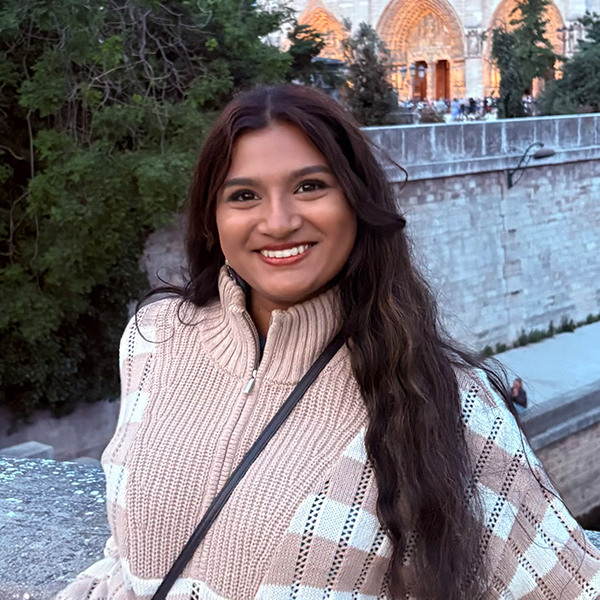
Aiswarya Nair
Humanities in Action Assistant
Aiswarya Nair is a first-year undergraduate student at Northeastern University, majoring in Health Sciences. Her interests include health equity, foreign policy, and the intersection between public health and social justice. She is passionate about social awareness and change. Through her studies, she aims to research how social and political structures influence access to healthcare and advocate for more equitable systems.

Keir Nason
Research Assistant
Keir Nason is a first-year graduate student at Northeastern University, studying for a Masters in History. His interests include social history and the history of LGBT community, both in America and across the world. He hopes to use digital tools to make historical topics more accessible to more people.