
Report on the Research Process: Warya Duarte Mazuze
April 2026
When I first started researching, I had never heard of Estelle’s, nor had I heard of the Boston Chronicle. In the very first week, it felt like jumping into the deep end of the pool with only a faint understanding of swimming. Fortunately, I did have floaties to help keep my head above water, namely, my knowledge of how to use Zotero and Dr. Uta, whom I could ask for clarification whenever necessary. My first step on the research journey was to figure out how to use the repository (Digital Commonwealth) to help me narrow down how many sources I would be looking into. I did this by searching for Estelle’s within the repository’s Boston Chronicle folder. It didn’t take long for me to figure out that the database couldn’t pull only the newspapers that mentioned Estelle’s, and that I would have to go through them all to complete my assignment. All 600 of them. This realization scared me because, at that point, I thought I only had a month to do it. I realize now that there was nothing to be worried about, as in this project, time is flexible and was extended as necessary.
To me, going through the newspapers and putting the metadata into Zotero was honestly the easiest part of the process, as after a while, it becomes automatic. Your body gets used to the movements, and you get better at spotting important information. Nevertheless, feedback is not always the easiest thing to receive. Being told to improve how we format the metadata, as well as the quality of the screenshots that we are putting into Zotero, which, as can be seen in Figure 1, was indeed a necessity. Having to redo some parts and start being more intentional with others, although frustrating, was also a learning experience. Feedback reception is always a good thing to practise, but most importantly, this feedback highlighted the importance of the work we were doing and how imperative it is that we do it correctly.
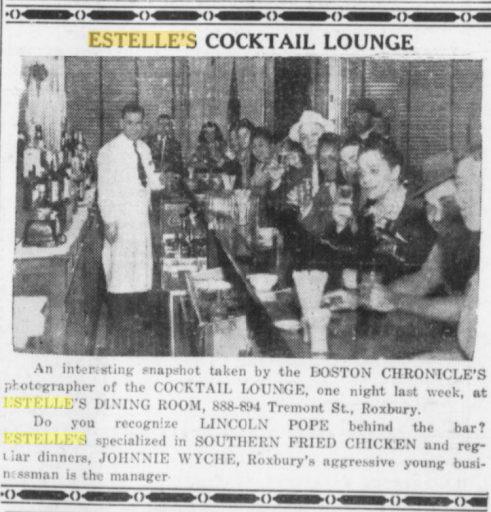
Overall, learning about Estelle’s was a really fun experience. Discovering more about the restaurant as I went through more newspapers was like piecing a puzzle together, and each mention was a little spot of it being completed. I have to mention, though, that the Context and information given to us at the beginning by Dr. Uta was like a skeleton to my research, allowing me to have somewhere to start from. Reading this draft was invaluable because it gave me a foothold in the research and stopped me from feeling like I was stumbling in the dark.
I was especially intrigued by how much more Estelle’s was mentioned in the Boston Chronicle compared to the other newspapers. The newspaper features Estelle’s manager at the time – John E. Wyche – in several articles, detailing how the restaurant got to its community hub position and praising both manager and establishment on this achievement. One such article is seen in Figure 2. This clearly depicts how not finding information in one source does not mean it won’t be in other sources, perhaps in even more abundance. This also intrigued me because with the incredibly positive image that the Boston Chronicles portrays of Estelle’s, it is shocking that it is not as mentioned in other major black newspapers in the Boston area. According to the Chronicle’s reporting, Estelle’s was the place to be and the location of many major events in the area. In all honesty, if all my information about Estelle’s came from the Boston Chronicle, and I were about to do a trip to Boston, Estelle’s would be a place I could not miss in my tour of Boston.
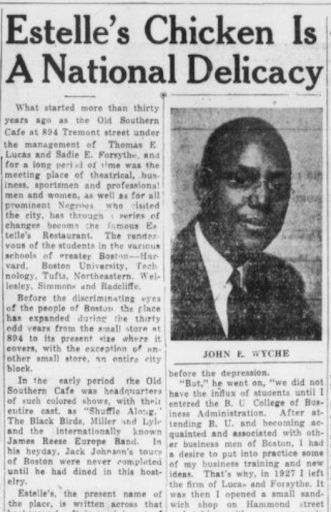
This shows me that different sources can either be biased towards or more focused on a specific topic. Lastly, doing research into Estelle’s and uncovering the effects and role of the restaurant on Black Boston healed a little part of my soul as someone coming from a country with a history that was unfortunately erased.
As always, some things could have been improved in this process, mainly the ability to narrow down the search to only newspapers that explicitly mention Estelle’s. Not being able to do this meant that I had to go through each newspaper, even the ones that did not have any mention of Estelle’s, thus wasting valuable time. Another issue that came up was the fact that the keyword search feature of the repository did not always work best, meaning that an important mention of Estelle’s might have been missed due to the system not being the most efficient. Initially, I struggled quite a lot with reading the newspaper in terms of the continuity of the articles from page to page, slowing down the process of identifying important information and locating the article that the mention is coming from. Looking back, I believe I would have benefited from spending a few minutes learning how newspapers are laid out so that I wouldn’t have to spend so much time trying to figure it out for myself.
Through my research, I gained insight into the Boston Chronicle and all that it had to give. What once upon a time used to be a way for the black community in Boston to connect and communicate is now our biggest and brightest window into a not-so-distant past. The Chronicle is an invaluable asset when it comes to researching Black Boston in the 1910’s to 50’s. By providing community news, reports on events, businesses, and important persons in the community, the newspaper allows us to follow stories that would have otherwise been ignored.
All in all, it was a pleasant experience that, in more ways than one, fanned my flame for research and giving people access to knowledge. Teaching me more about the city that I am soon to call home, and in the same boat, providing more sources for projects like Reckonings to use in the education of our society, something that I am proud to have participated in.